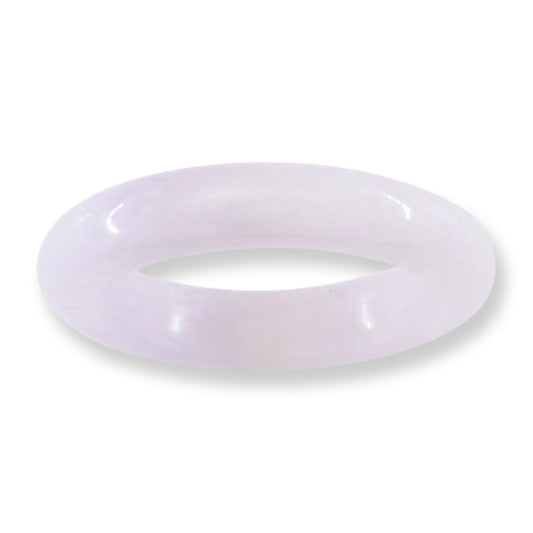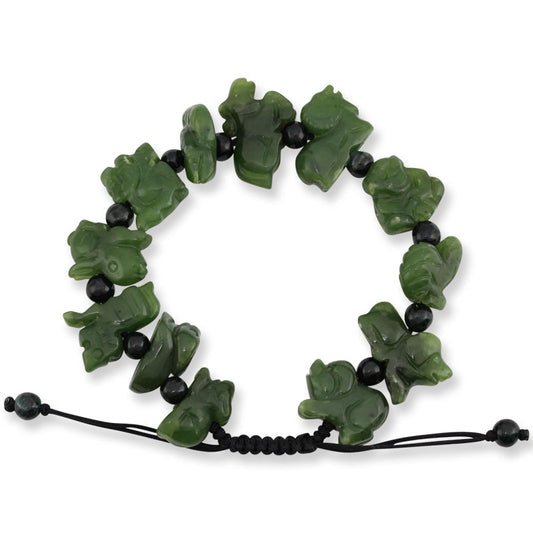

In China, a young girl may put on a bangle as a child and grow into it - until it's no longer able to come off, and wear it for the rest of her life. While we don't necessarily endorse this in the US (Please don't lift weights in your jade bangle...), it's easy to see why a young woman would form such a bond with her jade bangle.
At Mason-Kay, we've long called jade bangles the "original" permanent jewelry (lol) and believe it's the perfect piece for everyday wear. Jade is tough, durable, and surprisingly hard to scratch. It feels cool and grounding on the skin, stacks beautifully with other jewelry, and in moments of stress, many people find themselves instinctively rubbing their bangle for comfort. Over time, it can start to feel less like an accessory, and more like an extension of yourself.
Jade sellers don't have to "sell" jade bangles. If you love them and want one to wear, it's all about finding the right one. Like Cinderella's slipper, there's a bangle out there for you that fits just right. It's the right aesthetic, the right size, and the right price.
Here are some shopping tips for jade bangle newbies, so that you can let the jade find you.

Photo courtesy of Jewels of the Trade
Nephrite Vs Jadeite
| Tip #1: Make sure that the bangle you buy is either nephrite jade or jadeite jade. Many bangles are sold simply as “jade,” which isn’t specific enough and often means another stone entirely. Always ask for clarification on the stone type and be discerning. Materials like quartz or agate don’t have the same toughness or longevity as true nephrite or jadeite jade. |
The number one thing you need to know before shopping for a jade bangle is that there are two gemstones gemologically considered jade in the USA: Nephrite jade and jadeite jade. Anything else being labeled "jade" just means "beautiful stone," and you'll often see the term "jade" associated with serpentine, quartz, agate, and many other gems.

Photo courtesy of Jewels of the Trade
Nephrite jade is the jade of ancient China. tougher (meaning harder to break) than any other gemstone. It's traditionally more valued as art objects rather than used in fine jewelry. For jewelry, it’s rare to see nephrite bead strands or bangles sell for over $20k, though nephrite rough and carvings can easily reach six figures.
Jadeite jade, on the other hand, is better suited for ultra-fine jewelry. It’s more resistant to scratching (which is why it performs well in rings), and its colors tend to be more vivid and highly prized. In fact, $20k is considered low-end for fine jadeite bead strands or bangles—giving you a sense of just how much more highly valued jadeite is in jewelry.

(Left) B+C Jade - meaning jadeite jade that has been dyed and impregnated with polymer
(Right) A Jade - meaning natural, untreated jadeite jade
Detection of polymer impregnation can sometimes be impossible without advanced gemological testing. Learn more about Mason-Kay's jade testing services.
Jadeite Jade: Natural Vs Treated
| Tip #2: Don't overpay for treated jade! If you want your jadeite jade to last longer, be stable in color, and retain value - buy natural (untreated) jadeite jade. (Note: Nephrite jade in jewelry is rarely treated, so this isn't a concern for nephrite shoppers.) |
The vast majority of jadeite jade on the market is treated, and most of it is being sold without disclosure. This is why it's imperative that you shop with a seller you trust. At Mason-Kay, we test and guarantee every piece of jadeite jade to verify that it's natural and untreated.
'B' Jade (polymer, wax or resin impregnated jadeite jade) is worth 5-10% the value of it's natural jade counterpart.
'C' Jade (dyed jadeite jade) is virtually worthless, fetching only $20-$50 per piece regardless of size and appearance.
Most treated jade on the market is B+C Jade, which is a combination of both treatments. These stones are brittle (easy to break), unstable in color (meaning they can change color over time), and have little to no value.

Bangle Sizing
| Tip #3: Your bangle size is based on your hand width, not your wrist. |
Visit our Bangle Size Info page to learn about bangle sizing!

Grey jadeite jade bangle on bottom, black nephrite jade bangle on top.
Jade Quality Factors
| Tip #4: Pay close attention to texture and translucency, not just color, and be aware of fractures and other potential problems that the stone may hide. |
The nature of jade pricing is quite complicated, and is determined by a number of factors. In this article, we are focusing on jadeite jade quality factors, not nephrite.
Translucency.
Translucency, or the ability for light to transmit through the material, is determined by the internal microstructure of the jade. The tighter the structure, the tougher the material, the more translucent the jade will be.
Texture.
When sellers talk about texture in jadeite jade, they’re often referring to a set of overlapping characteristics, rather than a single, clearly defined trait. Concepts like luster, crystal (or grain) size, color patterns and inclusions, and surface feel all fall under the broader texture umbrella, and different sellers may mean any one of these, or several at once. (Again - This discussion applies to jadeite jade only, not nephrite.)
Luster is closely tied to translucency and reflects how compact jadeite’s internal microstructure is. It describes how light interacts with the surface of the stone. Jadeite jade typically shows a primarily glassy luster with a secondary greasy quality, and higher-quality material reflects light cleanly and evenly.
Crystal size, sometimes called grain size, is especially important. Jadeite jade is a polycrystalline aggregate, made up of microscopic crystals interlocked together. The smaller and more compact these crystals are, the tougher and more translucent the jadeite becomes. Larger crystals can reflect light individually, creating a granular, “sugary” appearance that indicates poorer texture. Large grain size may indicate a durability issue if you can see the flat crystal faces reflecting light. To the untrained eye, this may be difficult to detect - so always shop with a seller you trust.
Color patterns and inclusions also influence how texture is perceived. Elements like chromium may concentrate unevenly, producing variations in color and saturation, while other minerals, such as albite or mica, appear as "inclusions." (Not sure inclusions is the right word here, but you get the gist.)
These visual features are often what sellers are referencing when they describe a jadeite’s “texture.”
Finally, there’s surface feel, or tactility. High-quality jadeite feels glassy and smooth in the hand, while a dry or chalky feel is generally a sign of inferior texture.
Color.
Green is the most valuable color of jadeite jade, but that doesn't mean all green jadeite jade is valuable. Nor does it mean that a green jade stone is always going to be more valuable than a lavender jade stone. There are low and quality stones in all of the colors of jade, ranging in prices from fun to fine.
Color is evaluated based on hue, tone, and saturation.
Hue is the actual color, and in most gemstones – a true color is most desirable. Meaning that jade is more rare and more valuable if it’s closer to a true-green than a blue-green.
Tone sort of refers to lightness and darkness of a gemstone, but in the case of jade, it usually refers to grayness. The less gray, the better.
Saturation refers to the richness of the color – and this has a huge influence on value, as lesser saturated jades are more common – and higher saturated jades are more rare.
Beware of:
| Tip #5: Be extra cautious when shopping online, and don't be afraid to ask questions and use your intuition when evaluating a jade seller. |
We're not saying you shouldn’t buy bangles through live sales or online, just that there are a few things to keep in mind when you’re shopping from sellers you don’t already know.
Overseas Sellers. If you order a bangle from overseas and need to return it, you may have very little recourse if the seller refuses a refund.
Jade in photographs. Jade is notoriously fickle on camera and almost always looks different in person. Be discerning about lighting, angles, and how the piece is presented, and trust your instincts. If it feels like details are being glossed over or certain views are avoided, that’s worth paying attention to.
Many customers report that texture typically looks better on camera, and color can often look distorted as well even if unintentionally. Don't be afraid to ask for additional photos or videos of a piece in varying lighting conditions, especially if the lighting in the initial photo/video looks "too perfect." Ideally, you want the piece to look better in person than it does in photos - not the other way around.
The flashlight. You may have heard Jordan mention this on Jewels of the Trade: some sellers will over-use and under-explain the flashlight. The purpose of using a flashlight to buy jade is so that you can see hidden fractures in the stone. If the flashlight is being used to make a piece seem more translucent than it is, you may be disappointed when your bangle comes in. Jordan discusses this at length in this video:
Bangle Thickness
| Tip #6: Medium to wide bangles are just fine, but don't buy a noticeably thin or "dainty" bangle. It's much more likely to break. |
When it comes to bangle thickness, there isn’t a magic millimeter measurement that every bangle needs to hit. The bangles available from Mason-Kay all have a solid, durable width, generally around 8mm and up, but what matters most is proportion.
Larger bangle sizes typically need more width to maintain strength. What you don’t want are ultra-thin bangles. ...You know the ones. If it looks noticeably dainty, it’s much more likely to break, so honestly, just don’t even go there.
What Not to Do While Wearing a Bangle
| Tip #7: You can do most everyday activities in a bangle, but the danger is when you go to take it off. |
For the most part, a natural jade bangle with good translucency and texture and no internal fractures is suitable to wear every day for the rest of your life. Obviously, you shouldn't do exercises where a weight may land on your wrist (i.e. kettlebells), but it's fine to sleep and shower in your jade bangle provided there is no gold on it.
The big risk is when you remove your bangle. Many people break their bangles when they fling it off their hand and it hits a tile floor. Remove your jade bangle over your bed or another soft surface, and never over tile or concrete.

What to Do if Your Bangle Breaks
| Tip #8: If your jade bangle fractures, send it to Mason-Kay for a hinge-and-clasp. |
If your jade bangle fractures but doesn't break all the way through - stop what you're doing. Remove the bangle, and ask your local jeweler or Mason-Kay to put a gold sleeve on it to protect it.
If your bangle breaks all the way through, consider having it cut on the other side too so that it can be turned into a hinge-and-clasp bangle. If your jade bangle is natural and untreated, this is a service Mason-Kay can offer you. However, we do not work on treated jade jewelry.