

Guatemalan Jadeite Jade from Mason-Kay Jade
What would Emperor Qianlong have done if he'd know there was material like this Guatemala? ...Would he have tried to find it?
Before the trade routes to Burma were even thought of, before the word “imperial” became marketing language, there was jade in the Motagua River region of Guatemala.
The jade of the Maya.

Guatemalan Jadeite Jade from Mason-Kay Jade
But wait. Isn't Guatemalan jade blue?
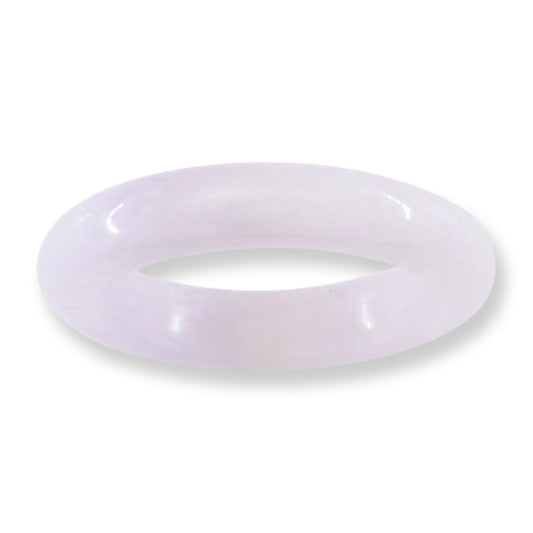
Translucent jades from Guatemala are considered high quality for the locale, despite their unusual color. In fact, the grey-blue hue has captivated jade customers because it feels more modern and less traditional. It pairs beautifully with other jewelry and often appeals to younger buyers and men.
That said, Guatemalan jade comes in a wide range of colors, including green, blue, lavender, white, and black. It’s also well known for its distinctive yellow rind, which artists often incorporate into their carvings.

Burmese vs Guatemalan Jadeite Jade from Mason-Kay Jade
Is Guatemalan jade treated?
Short answer: Ours isn't ;)
Make sure you’re shopping with a trustworthy seller so you don’t accidentally overpay for treated jade thinking it’s natural. Dyed jadeite has almost no value, and jadeite that has been impregnated with polymer, wax, or resin is typically worth only about 5–10% of the value of its natural counterpart.
Most treated jade on the market is both dyed and impregnated. That combination makes it more prone to breakage, unstable in color, and ultimately far less valuable — so don’t get bamboozled. Always confirm that what you’re buying is natural and untreated.
Which brings us back to the question: is Guatemalan jade treated?
So far, we’re not seeing treated material being sold as high-quality Guatemalan jadeite. But that doesn’t mean it couldn’t happen. There are already simulants on the market being sold as Guatemalan jade.
Could low-quality Guatemalan jade be treated? Of course.
But once it’s dyed and polymer-impregnated, there’s no reliable way to determine its geographic origin through standard gemological testing. There’s a rumor floating around that Guatemalan jade “can’t” be treated, and that’s simply not true.
The real issue isn’t whether it can be treated, but whether you’re buying from someone transparent and knowledgeable about what they’re selling. Every piece we sell at Mason-Kay has been tested and guaranteed natural, meaning untreated.

Guatemalan Jadeite Jade from Mason-Kay Jade
Fine Guatemalan Green Jadeite Jade
In China, many sellers are marketing their fine green Guatemalan jadeite jade as Burmese, or not disclosing origin at all. This makes it more difficult to identify fine-quality Guatemalan green jadeite jade, but it's not impossible.

Sold - Fine Guatemalan Green Jadeite Jade Bracelet from Mason-Kay
How can you tell if jadeite jade is Guatemalan?
First — color alone is not proof of origin.
Not all blue jade is Guatemalan. There is blue material from Myanmar (Burmese jadeite), although it’s rarely seen on the American market. Some Burmese blues are inkier and more saturated, and a trained eye can often separate the two.
But what about green?

Does fine Guatemalan green look identical to translucent Burmese green? Not exactly.
There isn’t a large volume of fine green Guatemalan material in the U.S. market. However, customers are seeing it in China — typically as small cabochons, beads, and carvings. A common format is small hollow Buddhas with foil backing to enhance color.
Fine Guatemalan green often:
- Shows a darker rim or inky edge
- Has a slightly bluish-green cast
- Comes in smaller sizes
That said, there are always exceptions. Visual cues can guide you, but they’re not definitive. You cannot be 100% certain of geographic origin without advanced laboratory testing.
That’s why Gemological Institute of America (GIA) offers origin determination services for jadeite. At present, they provide origin reports for Burmese and Guatemalan jadeite. They’re continuing to build a reference database with the goal of eventually distinguishing other sources — including Russian, Japanese, Kazakh, and additional origins.
| Note: If you want to have your jade tested, but don't need to know origin, you can send your jade stone or jade jewelry to Mason-Kay for testing. We're able to offer printed and verbal reports on whether or not your stone is jadeite jade, and whether it's natural. And we offer valuation services as well. Learn more here. |
Watch this video at 35:15 to see a side-by-side comparison of Burmese vs Guatemalan green jade, showing the "dark rim" that can be indicative of origin. Examples of fine Burmese jade also shown at 38:20.
What is Imperial Jade?
Check out these articles and come back here:
Imperial Jade Defined
Jade Value by Color
Short Answer: Imperial Jade is a trade term, so it doesn't necessarily have a universally agreed-upon definition. But it should refer to the highest quality of jadeite jade that has high translucency, exceptional color and texture, and an inner glow.

Above - Near-Imperial vs Imperial Quality Comparison from Mason-Kay Jade. Likely Burmese origin.

Fine Guatemalan Green Jadeite Jade from Mason-Kay
So. Is the Fine Guatemalan Green considered "Imperial?"
It’s checking a lot of the boxes. It’s highly saturated, it’s translucent, it has great texture.
Here’s the thing about “imperial jade.”
Imperial is a trade term. It’s not scientific, it’s a judgement call. And it conveys to the customers that this is beyond exceptional jade, so obviously, sellers have a motivation to call as much jade as imperial as they can so that they can charge higher prices.
Additional confusion in the American market is created by the Latin American jade trade where imperial tends to just mean green because, well, language is complicated.
At Mason-Kay, we have very specific standards for imperial to prevent misunderstanding.

In the above video from Jewels of the Trade, Jordan (oh hey that's me!) is showing a comparison between Burmese jade (left) and Guatemalan jade (right). When you see them side-by-side, the Burmese jade is less blue and closer to a true-green. However, the Burmese stone (left) still isn't considered imperial.
So how can we call the Guatemalan jade seen above "imperial?"
Can some Guatemalan jade be imperial? It is absolutely possible.
However, the pieces that are being seen in the market right now should be considered fine quality. As in, from bottom to top: Commercial, Medium, Fine, and then Imperial (Ultra-Fine).
This is beautiful jade. That said, we wouldn't call it “imperial.” And frankly, we don't want to have to charge more for it - and if it were considered imperial, then we would.
Overusing trade terms (like imperial) muddies the waters and makes it harder to communicate clearly about jade quality. Spanish-speaking sellers sometimes call this color esmeralda.
In China, it’s typically not marketed as “Guatemalan” at all. Instead, the same quality standards used for fine Burmese green are applied to fine Guatemalan green — and that’s acceptable.

At the end of the day, this is fine-quality green jadeite: highly saturated (even slightly dark), translucent, and valuable. A seller doesn’t necessarily have to disclose geographic origin — they may not even know it — but at Mason-Kay, we believe in sharing as much information as possible so customers can make informed decisions.
The Chinese Market for Fine Guatemalan
Let’s talk about how this material is viewed in the Chinese market. Many sellers in China tend to devalue Guatemalan jade. Some of that may be cultural preference, but there’s also economic incentive: if the material is perceived as less desirable, it can be purchased from Guatemala at lower prices.
So naturally, there’s motivation to downplay it.
You’ll sometimes hear claims that Guatemalan jade “changes color.”
It does not.
Natural jadeite jade does not change color, regardless of origin.
Fine-quality material is also not always disclosed as Guatemalan in China. To be fair, some sellers may not actually know the origin. For now, there is a bit of a price gap: fine Guatemalan jadeite jade often sells for less than comparable Burmese material of similar quality. It's worth mentioning that while they are comparable, they are not identical.
Will fine Guatemalan green continue to be less expensive than Burmese going forward?
At this time, we don't know.

Sketchy Practices in Selling Guatemalan Jade
(aka, things that Mason-Kay does not do)
Hollow cabs with foil backing.
A lot of Guatemalan jade is cut very small. Because it's so dark, carvers will hollow out the bottom and back it with foil to make it look brighter and more translucent.

Enhancing photos/videos.
I think is self-explanatory.

Overusing and under-explaining the flashlight.
(Can you guys tell that Jordan from Jewels of the Trade wrote this article? lol)
The image below features a bangle lit by a flashlight. The direct light shows off it's translucency and blue color, but without context, it may be misleading.

What makes Guatemalan jade so special?
Utilized by seven different Mesoamerican civilizations, jade was once a booming economy in Central America. Used as currency, jewelry, weapons and tools, jade was revered by Mayan and Aztec kings until the Spanish Conquest - which banned the jade trade in the 1500s. Within a generation, the memory of jade was lost and forgotten until the 20th Century.
Even after jade’s rediscovery by Jay and Mary Lou Ridinger in the 1970s, Guatemala did not realize they even had jade - nonetheless a past culture surrounding it.
Since its rediscovery, Guatemala has brought back its jade culture and carving industry, honoring Guatemala’s Mayan heritage and exciting history.
Bringing Guatemalan jade to the greater international jade market has taken time. The late Fred Ward, a National Geographic journalist, brought a lot of attention to the stone with his famous article on jade in the 1970s.
Guatemala’s annual Jade Congress showcases Latin American jade carvers, some of which have been invited to compete in Suzhou at the prestigious jade carving competition Zi Gang Bei - notably Noe Sanchez and Adan Pilicastro.
The Monterey Bay Jade Festival and the International Jade Summit are also building awareness of Guatemalan jade in the USA as a way to support jade sources that are closer to home.

It's just a shame to sell material as beautiful as this and not tell the customer where it truly came from.
If you want to dive deeper, check out the video!