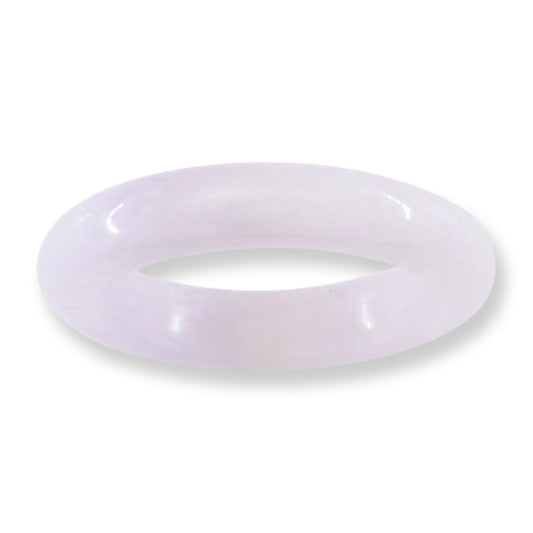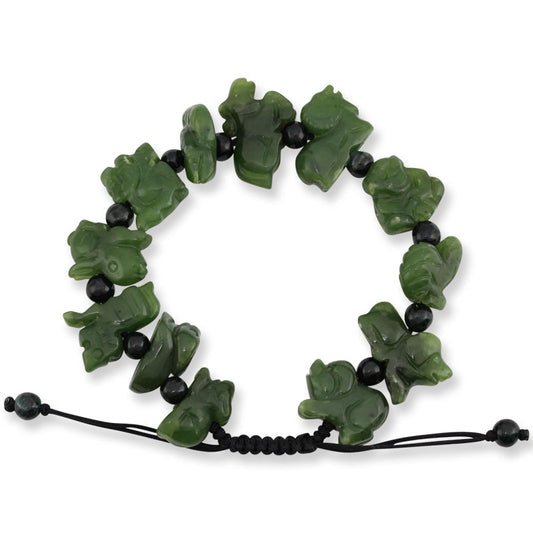


Jade bangles are having a moment right now, as customers in the U.S. are discovering and appreciating the beauty of Chinese jewelry traditions and symbolism.
You may be seeing the hype online, especially among younger customers, surrounding jade bangle bracelets as a trend. Fret not, this isn't some fad that will come and go. In fact, this is one of the longest standing trends in history.
Whether you’re shopping for your first bangle or trying to understand the difference between what’s authentic and what’s not, this guide will walk you through everything you need to know before you buy.
Throughout the article, we'll include a number of videos as well to help you as you dive down the rabbit hole. Consider this page your go-to authority on nephrite jade and jadeite jade bangles.
Jade bangle livestream featuring Kris the Jade Lady. Live selling is part of the reason that demand for jade bangles continues to grow.
The History of Jade Bangles
Also called "hololiths," jade bangles may be some of the oldest gemstone jewelry archaeologists have found. Discovered in Neolithic tombs, modern day scientists have found ancient jade bangles believed to be somewhere around 8,000 years old. Neolithic cultures such as the Liangzhu (over 4,000 years old) are now known to have loved and revered jade long before the rise of Imperial China.
The Two Jades
There are two gemstones called jade: nephrite jade and jadeite jade, also called fei cui. Whether you prefer one or the other when shopping for your bangle depends on personal preference.
It's better to see the two stones than to talk about them, so here are some links to help you see the difference:
Video: How to Tell the Difference Between Nephrite Jade and Jadeite Jade
Video: Jade Microscopy - Inclusions in Nephrite and Jadeite Jade
Video: Origins of Jade from 15+ Different Sources
Video: Inside California's Jade Carving Culture | 2025 Monterey Bay Jade Festival VIDEO TOUR
Article: Nephrite Jade vs Jadeite Jade - What's the Difference?
Article: Technical Characteristics of Nephrite Jade and Jadeite Jade Comparison Chart by Jeff Mason, G.G.
Genuine nephrite jade and natural jadeite jade available for sale from Mason-Kay Jade. Photos courtesy of Jewels of the Trade.

Nephrite Jade Bangles
Nephrite jade comes in an array of colors, but nephrite bangles are typically green, black, or white. Nephrite bangle colors such as lavender and blue tend to be hard to find on the American market. At Mason-Kay, we carry white nephrite bangles when available - but they sell fast and are hard to get.
Nephrite vs Jadeite Jade white bangle comparison, photo courtesy of Jewels of the Trade. Featured in this video.
White nephrite jade tends to be the most desirable color in nephrite, which is different from jadeite jade (fei cui) where green is the highest valued color. White nephrite jade is known to come from various regions in China, Russia, and South Korea.
Jadeite Jade Bangles
Most of the jade bangles you see selling online are probably jadeite jade, due to their desirability on the Chinese market. Jadeite jade bangles come in a wide array of colors, particularly green, lavender, red (orange), yellow, grey, and white. Black jadeite jade bangles are quite rare in high qualities, so most of the black jade bangles we carry at Mason-Kay are actually nephrite jade.
Colors of jadeite jade bangles from Mason-Kay Jade. Photo courtesy of Jewels of the Trade, featured in this video.
 Mason-Kay's Colors of Jade Chart, learn more here.

Real Vs Fake Jade Bangles
Natural jadeite jade of gem-quality is truly rare, and the vast majority of products being sold as "natural jade" on the market are actually simulants or treated jade. When it comes to nephrite jade, this is typically less of a concern.
You want to make sure that the jade bangle you're buying is either genuine nephrite jade or natural, untreated 'A' jadeite jade (also called fei cui).
Natural jadeite jade available from Mason-Kay Jade. Photo courtesy of Jewels of the Trade.

Jade Simulants
Beware of common jade simulants such as dyed green quartz, agate, and chalcedony. Serpentine, aventurine, glass, and plastic may be quite easy to identify by appearance, but any of these make be marketed and sold as "natural jade" to unsuspecting jade buyers.
Natural jadeite jade available from Mason-Kay Jade. Photos courtesy of Jewels of the Trade.

Natural jadeite jade available from Mason-Kay Jade. Photos courtesy of Jewels of the Trade.

Natural Vs Treated Jade
Unfortunately, too many customers have been swindled by treated jade posing as natural. The reality is that once jadeite jade has been dyed, it's worth less than $50 no matter the size or appearance. Similarly, once jadeite jade has been impregnated with polymer, wax, or resin, it's worth around 5-10% the value of it's natural jade counterpart.
It's ok to buy treated jade if that's what you want, but it's important that you understand what you're buying. Many sellers do not disclose treatment of jade, and they don't warn customers about the downside of treated jade.
Here are the Jadeite Jade Treatment Codes:
(note that this does not apply to nephrite jade)
'A' Jade - Natural, untreated. May have a beeswax coating which does not affect appearance or value, and it is not permanent. Natural jadeite jade is durable, valuable, and stable in color.
'B' Jade - Genuine jadeite jade of extremely low quality that has been acid-bleached and impregnated with either polymer, wax, or resin. Impregnated jadeite jade is very brittle, has little value, and is unstable in color. Acid may even leak onto the wearer, and may emit an odor in cases where the piece has been fractured.
'C' Jade - Genuine jadeite jade that has been dyed. Dyed jadeite jade can change color over time.
'B+C' Jade - By far the most common jade treatment. This is a combination of 'B' and 'C.' 'B+C' Jade is often overpriced (as it's rarely disclosed,) it's very brittle, has little value, and is unstable in color.
Learn more here:
Article: Natural Vs Treated Jade by Jeff Mason G.G.
Detecting Fractures
At Mason-Kay Jade, we pride ourselves on our high standards of quality for inventory. We never drop-ship. Every piece has been inspected in person (by GIA Graduate Gemologist Jeff Mason and jade jewelry designer Kristina Mason) and ships from our main office in Centennial, Colorado - which is run by company owners Jeff and Kristina Mason.
Backlit external jadeite jade fracture under a microscope. Photo courtesy of Jewels of the Trade. Featured in this video.

Backlit internal nephrite jade fracture under a macro lens. Photo courtesy of Jewels of the Trade. Featured in this video.

We want the jade bangles we sell to be durable and longlasting, so we have a discerning eye for characteristics that may pose problems down the road - such as internal fractures. We always check bangles under a microscope and with a flashlight to make sure they are not fractured.
Online sellers can easily hide internal fractures in bangles, which is why it's important to shop with a trustworthy seller with a return policy.
Jadeite Jade Bangle Colors
Green tends to be the most desirable color for jade bangles. Lavender is also highly desirable, but can easily be expensive when saturated in color. Yellow and red jade is typically affordable, but in the case of bangles, these colors are actually quite rare as they come from the rind of the jade boulder - where there typically isn't enough material to cut a bangle from.

White Jadeite Jade vs White Nephrite Jade
Look at the photo below. Do you think this is white jadeite jade...or white nephrite jade?
White jadeite jade bangle from Mason-Kay Jade. Photo courtesy of Jewels of the Trade, as featured in this video.

If you said white jadeite jade, you would be correct. Whereas jadeite jade tends to be more valuable in colors such as green and lavender, it's typically more affordable in the color white. This is very different from nephrite jade, which is often more valuable than nephrite of other colors. Side-by-side, a white nephrite jade bangle is often going to be more valuable than a white jadeite jade bangle.
White nephrite jade and white jadeite jade bangles from Mason-Kay Jade. Photo courtesy of Jewels of the Trade, as featured in this video.

Grey Jadeite Jade vs Black Nephrite Jade
Black jadeite jade in high qualities (characterized by high translucency, resulting in a green glow when lit by a flashlight) is quite rare - especially in bangles. Lower quality black jadeite jade bangles are available on the American market, but rarely meet Mason-Kay Jade's quality standards so we don't carry many of them for fear of them breaking.
Grey jadeite jade, left. Black nephrite jade, right. Both available from Mason-Kay Jade. Photo courtesy of Jewels of the Trade, as featured in this video.

Black nephrite jade, however, tends to be durable and quite affordable. So most of our truly black jade jewelry is actually made from black nephrite jade. For our jadeite jade lovers, we tend to carry more grey jade because it's still affordable without losing durability.
Learn more about the glow of black jadeite jade here.
Jadeite Jade Bangle Styles
Choosing your bangle style depends largely on personal preference. Do you prefer a wide or a thin width? Round or semi-round? Carved or solid? Do you prefer to have a hinge-and-clasp so that you can wear a smaller size around your wrist? Here are some photos to give you an idea of different styles, but there are so many more so be sure to check out our Jade Bangles Collection page for more style inspiration.
Wide Jade Bangle
Wide jade bangles are quite fashionable and durable. However, they may fit a little tighter than thinner bangles of equal inside diameter. With this in mind, you may need to order a slightly larger size when ordering a wide bangle.

Thin Jade Bangle
We typically don't recommend truly thin jade bangles, because they're more likely to break. We have high quality standards for what we offer in our inventory, and we do not carry bangles that are too thin to be durable.
Rounded Jade Bangle
Exactly what it sounds like, a rounded jade bangle style is cylindrical - like a pipe. Some sellers may call this style "princess," but we typically don't due to the confusion between the bangle cut and the square-cut of loose gemstones mainly known as "princess cut."
Semi-Round Jade Bangle
Perhaps the most common cut of bangle, semi-round refers to bangles that are rounded on top but flat on the inside.

Squared Jade Bangle
A modern, contemporary style that appeals to men and women alike.

Carved Jade Bangle
Some bangles are carved all the way around, and some are only carved in sections like the bangle below.

Common Myths about Jade Bangles
1. At-home testing.
The vast majority of information on the internet about at-home jade testing is inconclusive. Can you test your jade bangle at home to see if it's real or fake?
The Ping Test
Many online sources will try to tell you that if you strike a solid bangle and it emits a ping sound, then it must be natural, untreated jade. Here are the problems with this:
- Not all natural jade pings. A natural jade bangle will only ping if it has no internal fractures or inconsistencies with the microstructure (varying crystal sizes or directions, etc), and if it is highly translucent. So many opaque bangles will not ping, and yet, they are natural/untreated.
- Quartz bangles ping. Quartz is the #1 simulant of natural jade. It is more common than treated jade, and probably more common than all of jade's other simulants combined. And quartz has sonority, therefore it will ping.
If you test a bangle properly (for instance, using gemological testing such as refractometry) and can determine that the bangle is in fact jadeite jade - then it's worthwhile to test it for a ping. If it does ping, it's probably natural. If it is translucent but doesn't ping, then it may be treated. However, there are exceptions to every rule - so we recommend sending your jade bangle to a reputable laboratory for testing. If you don't want to send it to GIA or another large lab, Mason-Kay offers lab testing services.
The UV Test
There are hundreds of online videos promising that you can detect treatment in a jade bangle with a UV light. However, not all polymer will fluoresce. So if you hit your jade bangle with a UV light and it does not fluoresce, that doesn't really mean anything.
Additionally, the beeswax coating commonly applied to jade's surface is slightly fluorescent. So if your UV light does detect fluorescence, it's only an indicator of treatment if the fluorescence is high.
The Cold Test
Certain websites promise that if you touch a bangle and it's cold, it must be jade. There are two major problems with this test:
- Other gemstones can be cold.
- Jade can be warm if it's been sitting under a hot light, in the sun, or if it's been recently worn.
2. Does jade change color?
It's commonly believed that jade can change color.
There’s a long-standing belief that jade can change color based on the wearer’s health or emotions. While this idea is rooted in culture, there are a few scientific and environmental reasons why jade might appear to change color:
-
Lighting Effects: Because of its translucency, jade can look different under various lighting conditions. This isn’t a change in the stone itself—it’s simply how light interacts with its surface and internal structure.
-
Beeswax Coating Wear: Natural jadeite jade that has been carved in China is often coated with a thin layer of beeswax to protect the porosity of the stone from outside chemicals the wearer may come in contact with. **Note: The beeswax does not affect the color, appearance, or value of the jade. Also, the beeswax is not permanent. Over time, this beeswax can wear away, exposing the stone to minor surface abrasions. These microscopic scratches can dull the appearance, giving the impression of a color change. Fortunately, a professional lapidary can easily polish the surface and restore the jade’s original luster.
-
Surface Reactions: Jade is a polycrystalline aggregate. A rock. Because it’s technically a rock, it has varying degrees of porosity – with higher quality jades being less porous. Once the beeswax coating has worn away, the surface of the jade may “absorb” (for lack of a better word) chemicals the wearer comes in contact with. This is why it’s important to rub your jade – your skin oil will replace the beeswax coating and essentially “protect” the jade. Everyday elements like skincare products, body oils (which are usually colorless, but may have color depending on your body chemistry), or strongly colored liquids can slightly affect how the jade looks—especially in lighter, more opaque pieces (To clarify: this really only applies to lower quality jades.) While these changes are usually not permanent, we recommend avoiding exposure to dyes or harsh chemicals to protect the jade’s surface.
- Treated Jade Confusion: Unfortunately, not all jade in the market is natural. Treated jade (often bleached, dyed and impregnated with either polymer, wax or resin) is unstable and prone to fading or discoloration over time. This has led many wearers to believe that their jade has “changed color” when, in fact, it was simply a treatment wearing off.
The bottom line is that natural, untreated jadeite does not undergo a true color change.
3. Do jade bangles break?
Yes and no. High quality, translucent jadeite jade bangles will not break easily. Nephrite jade bangles are even harder to break.
However, a jadeite jade bangle can break easily if it's not translucent, if it has internal fractures, and especially if it's dropped on concrete or brick.
As with all jewelry, treat your jade with care and respect. Jade bangles can be quite tough, and we hear stories all the time from customers who have whacked their bangles and not broken them. But the right circumstances combined with the wrong bangle can result in a break, so just be careful.
In China, young girls put a jade bangle on and grow into it so that it can't be taken off - and they wear it their whole life. Just be responsible.

How to Measure Your Bangle Size
We have a whole page dedicated to this, and we're including some videos below for the more visual learners.