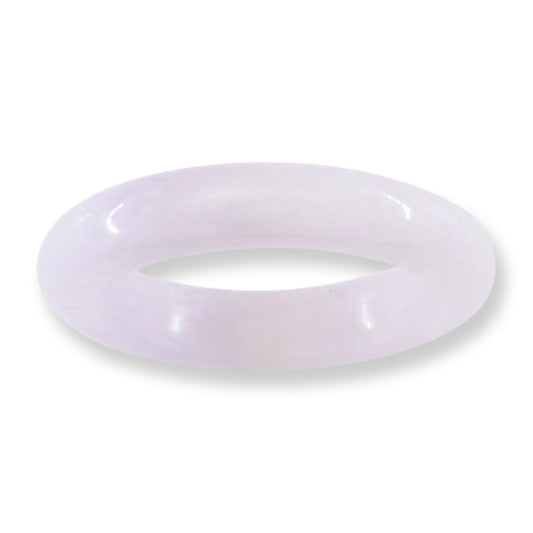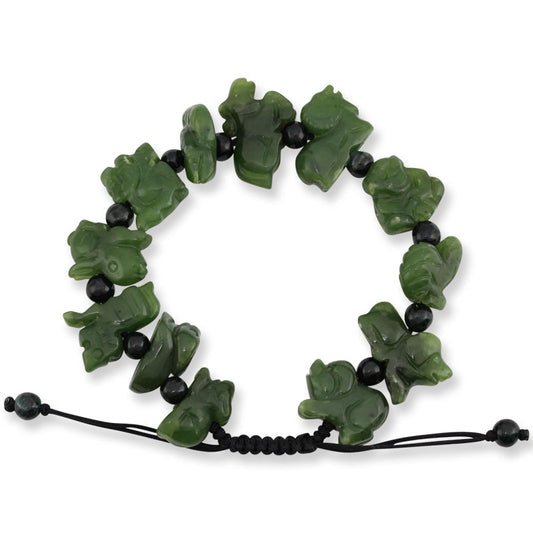

 Shop Water Jade from Mason-Kay Jade
Translucent jades are the toughest jades, putting ice jade and water jade as some of the most durable jadeite jade on the market.
See article The Toughness of Jade, American Mineralogist, Vol. 58


Shop Ice Jade from Mason-Kay Jade
Ice Jade
Jadeite jade (also called 'fei cui'), one of the two gemstones called "jade" in addition to nephrite jade, is comprised primarily of the minerals jadeite, omphacite, and kosmochlor (or a combination of these) when green. When colorless, the primary mineral in jadeite jade is jadeite.
Jadeite is allochromatic. This means that the color of jadeite is determined by the presence of trace elements in it's structure. When trace amounts of manganese or titanium are present, the color may be lavender. When trace amounts of chromium or iron are present, the color may be green. But when there are no trace elements, jadeite is colorless.
 Colorless jadeite can be either white jade or ice jade.
White jade is opaque and colorless, and may sometimes have bright hints of green called "moss-in-snow." Overall, white jadeite jade is very affordable -- unlike white nephrite jade, which is historically the most valuable color of nephrite jade.
 When colorless jade is translucent, however, it's considered ice jade.
Ice jade is a durable alternative to moonstone, and a common jade favorite for alternative engagement ring styles. While it doesn't have exactly the same phenomenon of adularescence as moonstone, ice jade does have an ethereal inner glow when cut properly. Ice jade represents purity and renewal, and is the third most valued color of jadeite jade.


Water Jade
Water jade is also called icy green jade, and is characterized by it's high level of translucence and light green color. Water jade can be highly valuable when the green color is even.

Water jade is aptly named because it looks like water. It has an inner glow, a glass luster, and might even look like water when blue-green in color. The pendant shown above is considered water jade, and some might say it has "floating flowers" referring to the darker inclusions that appear to be "floating" in the "water."
Blue jade is blue jade. If it’s icy, then it’s icy blue. In the American jewelry trade, we’ve used “ice jade” to refer to colorless translucent jade for a long time - and we use the term “icy” to mean translucent.
If you’re a seller and you’re calling blue jade “ice jade,” please consider modifying your nomenclature to help better how the trade communicates with customers.
I sometimes see blue jade called “blue ice,” I think that’s okay but the more appropriate term would be “icy blue.” This is how thousands of jewelry stores in the US refer to it, and I think it will be less confusing if online stores follow suit - but of course, that’s just my opinion you can take it or leave it.

This article from 2004, '‘Ice’ Jade—New or Not?' written by Gary Roskin for JCK Online, features an interview with Jeff Mason’s uncle Don Kay who co-founded Mason-Kay in the '70's with Jeff's father, Leon Mason.
Don explained in the article that “A few years ago, before very fine material was available, jade that was essentially colorless, as well as translucent, was called ‘water’ jade and was relatively cheap—about the same price range as very commercial green jade.”
But then, he goes to explain that around 1999 extremely fine examples of water jade appeared in the market.
What they were calling fine water jade was colorless, and it was more desirable at the time on the Chinese market so they had to distinguish it - and that’s when they started calling it ice jade. So this has been a thing for almost 30 years.

Qualities of Ice Jade
Ice jade follows all the same rules as other colored gemstones. The more rare, the more valuable. And it's quality is based on color (or lack of color, in this case), translucency, texture, size, cut, and matching (in the case of beads.)

In the image above, price increases from left to right.
Ice jade cabochons available from Mason-Kay Jade. Email kris@masonkay.com to purchase loose stones.
Color
Ice jade is more valuable if it has less of a yellow, green or blue hue and is truly colorless. However, if it's more green than ice (as in the case of water jade), then the greener the better. A fine water jade stone will usually be more valuable than an ice jade stone where all other factors (size, shape, etc) are equal.
Translucency
While a jade stone must be translucent to be considered ice jade, there are varying degrees of translucency. All other factors being equal, the more translucent ice jade stone will be more valuable.
 Texture
Even high-translucency ice jade stones can still have texture. The less texture, the better. Texture is difficult to define, but this image from Jewels of the Trade may help one understand a little better:
 Jade Texture photo credit: Jewels of the Trade
If you want to dive deeper into ice jade, check out this video from Jewels of the Trade: