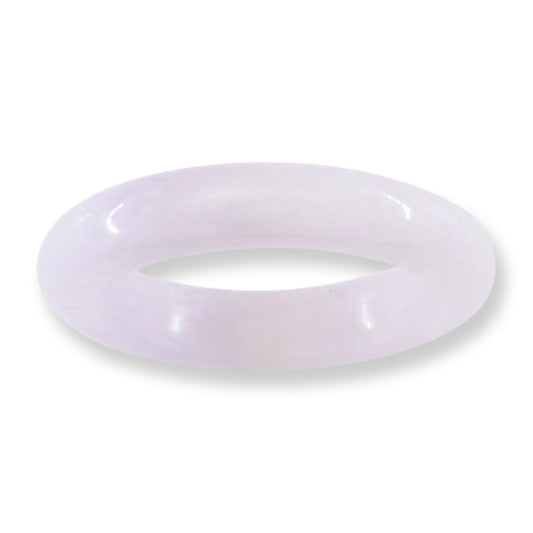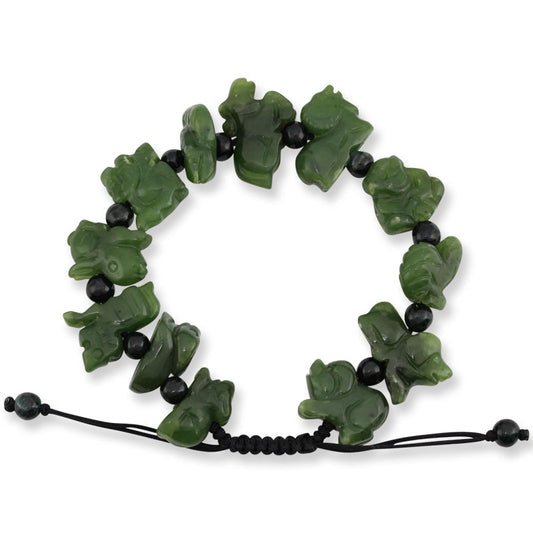


For thousands of years, Central Asian trade routes brought nephrite jade into China - building an industry around a stone that was revered by almost every Chinese dynasty.
Today, jadeite jade (also called 'fei cui') travels a new route in this modern era as Kazakhstan begins producing jadeite jade for the international market.
What do we call this jade?
Well, it's important that we point out that commercial Kazakh jade is jadeite jade (fei cui), not nephrite jade. This material can be referred to as Kazakhstan jade, Kazakhstani jade, Kazak jade, or Kazakh jade. These terms should only refer to fei cui jade (a pyroxene jade comprised principally or solely of any one or the following of these: jadeite, omphacite, or kosmochlor), not any simulants such as serpentine, quartz, grossular, etc.
Chemically, this is largely the same as jadeite jade from Myanmar/Burma, Guatemala, Russia, Japan, etc. In appearance, it most closely resembles Burmese and Russian jades.

Kazakh jade bangles from Mason-Kay Jade
Photo courtesy of Jewels of the Trade
Where does Kazakh jade come from?
At this time, the only significant mining operation exists in Itmurundy, Kazakhstan, near Lake Balkhash, where jadeite formed within the Junggar–Balkhash fold belt as ancient oceanic crust was subducted and transformed deep underground. It's hosted in serpentinite rock, which isn't abnormal for jadeite, and formed in typical subduction zone geological conditions under high pressures and low temperatures.

Kazakh jade bangles from Mason-Kay Jade
Photo courtesy of Jewels of the Trade
How long has Kazakh jade existed?
Geologically, it's believed to be around 300 million years old which would make it 2-3x older than Burmese is believed to be. Exactly how old it is, however, depends on what geological event is being dated and as with many ancient rocks, scientists continue to refine these estimates as new research and dating techniques become available.
Commercially, pieces of Kazakh jade have appeared on the market here and there over the years, but the current commercial operation - and the most significant there to date - began producing in 2025.
Previously owned by the Soviets, initial mining began in the 1970's - but because of jade's high silica content, much of this yield was devastatingly smelted for flux. This material was carelessly mined with explosives at the time in normal Soviet fashion, but things changed when a Russian company acquired the mine after the fall of the Soviet Union. During the 1990's, the Russians pulled out what was believed to be imperial and near-imperial material and sold it on the international market, leaving the commercial and lower grade boulders in a pile on the ground.
Thankfully, the mine came under new ownership in the 2000's, and has very recently started producing. Kazakhstan jade first debuted in the American market at the 2026 Monterey Bay Jade Festival, as reported by friend of jade D.D. Frontiere of the Roskin Gem News Report: US Debut of Kazakh Jade at the 2026 International Jade Summit

Kazakh jade bangles from Mason-Kay Jade
Photo courtesy of Jewels of the Trade
Is Kazakh Jade Natural?
Every piece of jade that we sell at Mason-Kay has been tested in-house and guaranteed natural, meaning free of dyes, polymer-impregnations, and other appearance-altering treatments than can affect value.
The only standard treatment for all jadeite jade is a thin, non-permanent layer of beeswax coating to protect the porosity of the stone. This beeswax does not affect the appearance or value of the jade.

Kazakh jade bangles from Mason-Kay Jade
Photo courtesy of Jewels of the Trade
How is Kazakh Jade Different from other Origins?
One must remember that Kazakh jade is brand new to the market, and they haven't yet scratched the surface when it comes to mining the material. The volume of available Kazakh jade material pales in comparison to jades from Myanmar/Burma and Guatemala. Regarding the appearance of Kazakh jade, some identifying characteristics may still remain unknown for many years.
So far, Kazakh jade seems to be closest in appearance to Burmese and Russian jades, and very unlike the Guatemalan material. It's not yet known if LA-MS-ICP testing will be able to conclusively identify Kazakh origin, but that research is in progress as far as we know.

Kazakh "Python Jade" bangle from Mason-Kay Jade
Photo courtesy of Jewels of the Trade
What about Python Jade?
Yeah, that one seems to be pretty unique. Python jade refers to Kazakhstan's brecciated material, also called conglomerate jade.
Breccia is when a bunch of jade rocks basically fuse together.
The Kazakhstan jade mine is on a tectonic boundary. So the earth is moving and jade is forming and reforming under low heat and high pressure. In cases of breccia, after the jade is formed, it gets broken up, and then metasomatic fluid fills the space between the already-formed jade and it cools, making a jade rock made of jade rocks. I
It's possible that the Kazakh brecciated jade looks distinctly different from Burmese brecciated jade, but more research needs to be done to determine whether or not the appearance of the breccia can conclusively identify origin.

How Much Does Kazakh Jade Cost?
At the time of writing this article, most of the material available is of very low quality in spite of having bright green hues. The color is typically not even (consistent, homogenous) across the piece, and the Kazakh jade tends to be quite opaque. It's still new to the market and prices may change quickly, but right now it's quite affordable. This is because of its quality though, not necessarily its origin.